Jessica Reel
The GuiltyJessica Reel is Will Robie’s sometime partner, a skilled operative whose importance is both practical and intimate: she can act decisively in danger, and she is the person Robie believes can understand what is happening inside his head. Her investigation into killings across several states brings her into the Cantrell case, where she helps connect scattered evidence to a hidden history of exploitation and murder. She is not simply Robie’s backup; she is a parallel investigator and the companion whose return gives his personal and professional struggles a point of connection.
Identity and Introduction
Reel belongs to a world in which Robie’s work is so secretive that the agency would never officially acknowledge his existence. In that isolation, she is one of the very few people he can count on. Blue Man is the other person identified as dependable, but Reel occupies a different place in Robie’s life: she is his sometime partner, and the one he turns to when he needs someone capable of understanding his inner state. Robie thinks even Blue Man cannot quite get all the way there.
That distinction defines Reel before she arrives in person. When Robie asks where she is, the question carries more than operational curiosity; he needs to talk things through with her. Her absence is therefore felt as a lack of understanding, not merely as a missing colleague. The narrative establishes the emotional significance of their relationship through Robie’s expectation that she will comprehend what others cannot, rather than through a lengthy explanation of their history.
Investigation in Cantrell
Reel enters the Cantrell plot with an independent assignment: she is working with ViCAP and investigating a possible serial killer. The case involves eight other killings across four states over nine years. She quickly tests the pattern instead of accepting the label at face value, calculating that the other murders appear to be spaced roughly eighteen months apart. She also asks whether there was a long interval between the killing of a girl and the murder of an older man in the other cases. Her questions show her method at work: she compares timing and victim sequence, looking for a recurring structure that might link crimes separated by place and time.
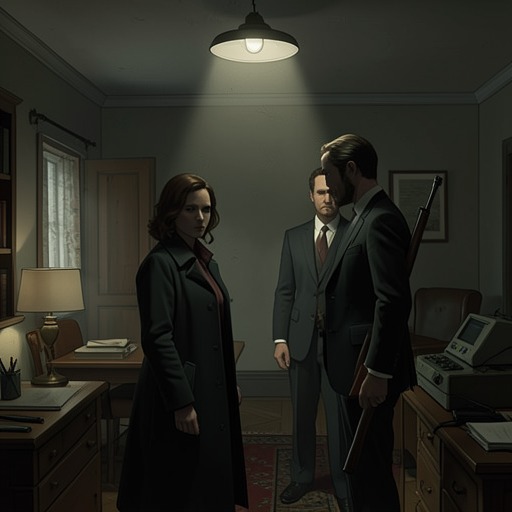
Her assignment intersects with Robie’s local investigation, but the intersection is not initially self-evident. Reel appears at the practice range with a rifle over her shoulder, a conspicuous arrival that prompts Robie to ask what she is doing there. Later, Robie argues that she should be allowed to stay because she can help with the matter the two of them had discussed. Her presence thus moves from surprise to acknowledged investigative value. The serial-killer inquiry supplies a wider frame for events in Cantrell, while the local case gives her a specific setting in which to test the possible connection.
The investigation also turns on questions about photographs and a shack at the back of a property. Reel asks how Robie’s father came by the pictures; the question is repeated as the inquiry continues, with the shack identified as the place behind the property. The repeated demand for the photographs’ origin matters because it presses beyond possession toward provenance: who obtained them, and how they entered the chain of evidence? The account does not, in these moments, resolve every detail of the pictures, but it shows Reel’s attention fixed on the circumstances that could make them meaningful.
Conduct Under Pressure
Reel’s investigative intelligence is matched by controlled action. In an armed encounter, she and Robie converge at once, guns aimed at their prey. When she fires, she does so methodically and with pinpoint accuracy, without haste. The contrast between the quick convergence and her unhurried shooting makes her competence legible in action: she can move immediately when danger demands it, then maintain deliberate control at the moment of firing.
Her role is not limited to the armed confrontations. Around the investigation, questions about the old crimes expose a network in which money, photographs, and blackmail connect people across households. Robie asks Cassandra Clancy when Sherman Clancy began blackmailing the person he had been paid to serve. Cassandra takes time before answering: she stubs out her cigarette, draws several long breaths, and begins. Reel’s casework is part of a larger process of bringing concealed relationships into view, even where another character delivers the account. The story’s accumulating details eventually change the meaning of the local killings: the violence is not an isolated puzzle but the consequence of an older, concealed history.
Partnership and the Revelation
Reel’s bond with Robie operates alongside, and sometimes beyond, their shared professional work. At one point after dinner, she returns to her room while Robie walks with Victoria around the rear grounds. The separation is ordinary and temporary, but it places Reel within a tense household whose members and secrets are not yet fully understood. Her ability to investigate there does not mean that she already knows the truth; rather, she is present as the personal and investigative strands of the story draw together.
The decisive revelation comes when Victoria admits that she killed Sara Chisum. She says she had told Sara that her father might have been the killer and urged her to leave town, offering help while pretending sympathy. Victoria explains that she did not want the arrangement involving older men and young women to continue, so she stopped it. She also admits that she had not expected Robie and Reel to be present when she killed Sara, and that seeing Sara in town had allowed her to arrange a meeting just off the road rather than in the clearing. The confession reframes Reel’s presence at the confrontation: she and Robie have been drawn into the case not by coincidence alone, but into the immediate aftermath of a murder Victoria had tried to control and conceal. When Robie insists that medical help is needed, the scene’s investigative struggle turns into an urgent human consequence.
Change and Narrative Role
Reel’s arc in the supplied narrative is less a transformation than a convergence of roles. She begins as the person Robie needs to reach, arrives as an armed colleague with a separate assignment, and becomes part of the inquiry that reveals the truth behind Sara’s death. Her questions help keep attention on patterns and origins; her precision makes her physically effective when the investigation becomes dangerous. Yet the story gives equal weight to her capacity to understand Robie, distinguishing their partnership from a purely tactical alliance.
The next day, Robie is reunited with Reel. Their reunion restores the companionship that his earlier thoughts had marked as missing. She tells him that they have each other and that, even when they fall, together they are unbeatable. The assurance does not erase the danger or the emotional damage surrounding them. Instead, it states what their partnership offers in the face of both: not invulnerability, but mutual reliance. Reel’s narrative significance rests in that combination. She is a disciplined investigator and markswoman, but also the person who can meet Robie at the point where professional competence alone is not enough.